
How to Build Your GTM Strategy Around the Product Urgency Spectrum
The “vitamin vs painkiller” framework has become gospel in product management circles. The conventional wisdom is simple: build painkillers, not vitamins. Painkillers solve urgent problems that people will pay for immediately, while vitamins are nice-to-have supplements that are easily skipped.
But this binary thinking is dangerously oversimplified. In reality, customer problems exist on a spectrum of urgency, and understanding exactly where your product sits on this spectrum is crucial for determining your go-to-market strategy, sales approach, and messaging.
Let me propose a more nuanced framework with four distinct layers of problem urgency, each requiring fundamentally different product and business strategies.
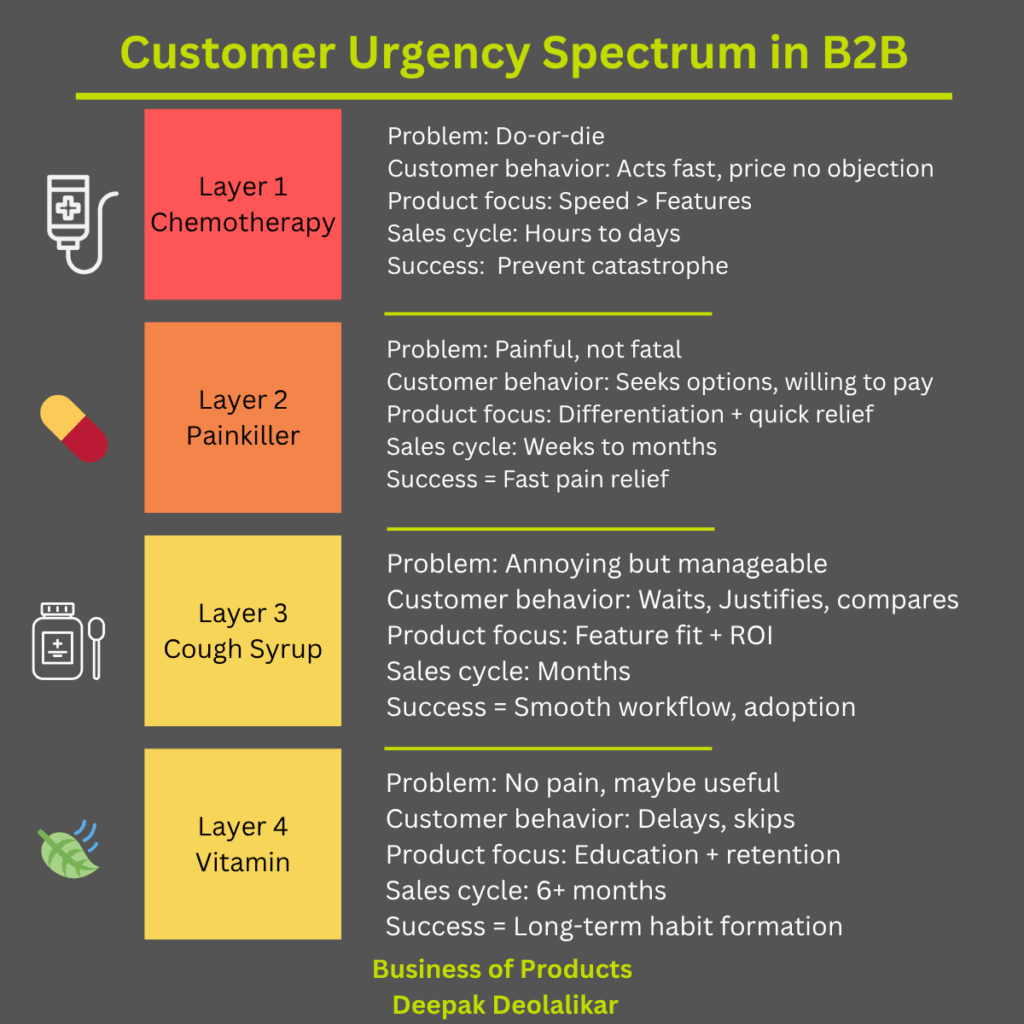
Layer 1: Chemotherapy – Existential Urgency
At the most extreme end of the spectrum are problems that threaten the very existence of a business or individual. Like chemotherapy for cancer patients, these solutions address do-or-die situations where failure to act means catastrophic consequences.
Characteristics:
-
Immediate, existential threat
-
Price sensitivity is minimal
-
Competitive comparison is secondary to speed and effectiveness
-
Decision-making is centralized and fast
-
Customer will pay almost any price for a solution
Examples:
-
Cybersecurity incident response: When a company discovers a data breach, they need immediate help. They’re not comparison shopping – they’re calling the first reputable security firm they can find.
-
Legal crisis management: A company facing a regulatory investigation or lawsuit needs legal counsel immediately. They’re not negotiating hourly rates.
-
System recovery solutions: When a company’s core systems go down, they need restoration services now. Downtime costs exponentially more than any recovery solution.
-
Emergency funding: A cash-strapped startup facing payroll in 48 hours will take funding at almost any terms.
Product Strategy Implications:
-
Focus on availability and speed of deployment over feature richness
-
Premium pricing is not only acceptable but expected
-
Sales cycles are measured in hours or days, not weeks
-
Word-of-mouth and reputation are your primary marketing channels
-
Customer success means preventing the catastrophic outcome, not optimizing for efficiency
Layer 2: Painkiller – High Urgency with Options
Traditional painkillers represent problems that are urgent and painful but not existential. Customers actively seek solutions and are willing to pay, but they have the luxury of comparison shopping and test alternatives. e.g. Blood pressure medication (unless life threatening). If you skip a day, you likely will not die. And you can shop which brand/ does combination is best for you.
Characteristics:
-
Clear, immediate pain point
-
Customers actively seek solutions
-
Price-sensitive but willing to pay for quality
-
Competitive evaluation is important
-
Few customers may delay or avoid treatment
Examples:
-
Recruiting software: Growing companies need to hire quickly, but they’ll evaluate multiple ATS solutions before deciding.
-
Expense management tools: Finance teams hate manual expense reporting, but they’ll demo several solutions to find the best fit.
-
Customer support platforms: Bad customer service hurts business, but companies will compare Zendesk, Intercom, and others before choosing.
-
Accounting software: Small businesses need bookkeeping help, but they’ll evaluate QuickBooks, Xero, and FreshBooks first.
Product Strategy Implications:
-
Strong competitive differentiation is crucial
-
Free trials and demos are essential for evaluation
-
Sales cycles are moderate (weeks to months)
-
Content marketing and comparison content perform well
-
Customer success focuses on immediate pain relief and quick time-to-value
Layer 3: Cough Syrup – Moderate Urgency, Specific Needs
Cough syrup problems are annoying and persistent but not debilitating. Customers want solutions but can be selective about timing and specific features. They might even wait to see if the problem resolves itself. Or maybe just sip warm water at home. Unless the degree of cough is really bad, in which case it might in #2 above.
Characteristics:
-
Persistent irritation or inefficiency
-
Customers can be specific about requirements
-
Price-conscious comparison shopping
-
Easy to postpone or work around but not for long
-
Feature fit is more important than speed
-
Clear ROI to justify is needed
Examples:
-
Marketing automation tools: Marketing teams want to automate campaigns but can survive with manual processes while they evaluate options.
-
Design collaboration software: Design teams want better collaboration but can continue using email and Slack while finding the right tool.
-
Time tracking applications: Consultants know they should track time better but can continue with spreadsheets while shopping for the perfect solution.
-
Social media management platforms: Social media managers want efficiency but can manually post while evaluating Buffer, Hootsuite, and others.
Product Strategy Implications:
-
Detailed feature comparison and customization options are important
-
Longer sales cycles (months) as customers take time to evaluate
-
Free tiers or extended trials help customers test fit
-
SEO and content marketing are crucial for discovery
-
Customer success focuses on workflow optimization and feature adoption (coughs generally takes weeks to resolve)
Layer 4: Vitamin – Long-term Hygiene, Easy to Skip
Vitamins represent long-term improvements or preventive measures. Customers understand the theoretical benefit but feel no immediate urgency. These are the easiest solutions to postpone indefinitely.
Characteristics:
-
Long-term benefits without immediate pain
-
Very easy to skip or delay
-
Extensive research and comparison
-
High churn risk
-
Requires education and habit formation
Examples:
-
Analytics and reporting tools: Companies know they should make more data-driven decisions but can continue with gut feelings and basic reports.
-
Employee wellness programs: HR knows wellness is important but can postpone implementation indefinitely.
-
Backup and disaster recovery: IT teams know they should have better backups but often delay until after a crisis, at which point they fall into #1 or #2.
-
Learning management systems: Companies want to upskill employees but training often gets deprioritized.
Product Strategy Implications:
-
Heavy investment in education and content marketing
-
Long sales cycles (6+ months) with multiple touchpoints
-
Strong onboarding and engagement strategies to prevent churn
-
ROI calculators and case success stories are essential
-
Customer success focuses on habit formation and proving long-term value
Strategic Implications for Product Managers
Understanding where your product sits on this urgency spectrum fundamentally changes how you should approach product development and go-to-market strategy:
For Chemotherapy products: Build for reliability and speed, not feature richness. Invest in customer success and incident response. Price for value, not market rates.
For Painkiller products: Focus on competitive differentiation and clear value propositions. Invest in sales enablement and comparison content. Balance features with usability.
For Cough Syrup products: Emphasize flexibility and customization. Invest in content marketing and SEO. Build comprehensive trial experiences.
For Vitamin products: Lead with education and long-term value propositions. Invest heavily in onboarding and engagement. Build strong communities and user habits.
The key insight is that there’s no universal “right” strategy – only the right strategy for your specific position on the urgency spectrum. A chemotherapy approach won’t work for vitamin problems, and a vitamin approach will fail for chemotherapy problems.
Before you design your next product roadmap or launch strategy, ask yourself: Are you building chemotherapy, a painkiller, cough syrup, or a vitamin?
Your answer should reshape everything from your pricing model to your sales process to your success metrics.
The most successful product managers don’t just build great products – they build great products with strategies perfectly matched to their position on the urgency spectrum.
