
Have you been asked to add AI to your product?
I recently taught a class of about 40 product managers. I started by saying: “If you think your job is to figure out where to add AI to your product, you’re still missing the point.”
Same blank stares.
Same response: “But that’s what everyone is asking me to do.”
The New Jira Ticket Is “Add AI to This”
A year ago, PMs were drowning in backlog grooming and JIRA engineering. Today they’re drowning in AI feature requests. Different packaging. Same problem.
Every exec wants an AI roadmap. Every competitor is announcing something. And PMs are scrambling to bolt on chatbots, copilots, and “intelligent” features without asking the basic question: does this make money?
That’s not a product strategy. That’s a feature factory with a better GPU.
Now, there is no harm in learning about AI, the models, how they work, limitations. In fact, that is a necessity for all PMs. Not just for productivity gains, but to see the potential of real impact to their customers.
But do not think that just knowing AI will make you a stellar PM.
Your job hasn’t changed. Build a business using your product. AI is a tool, not a strategy. And to do that well, here are the ten skills that matter more than ever.
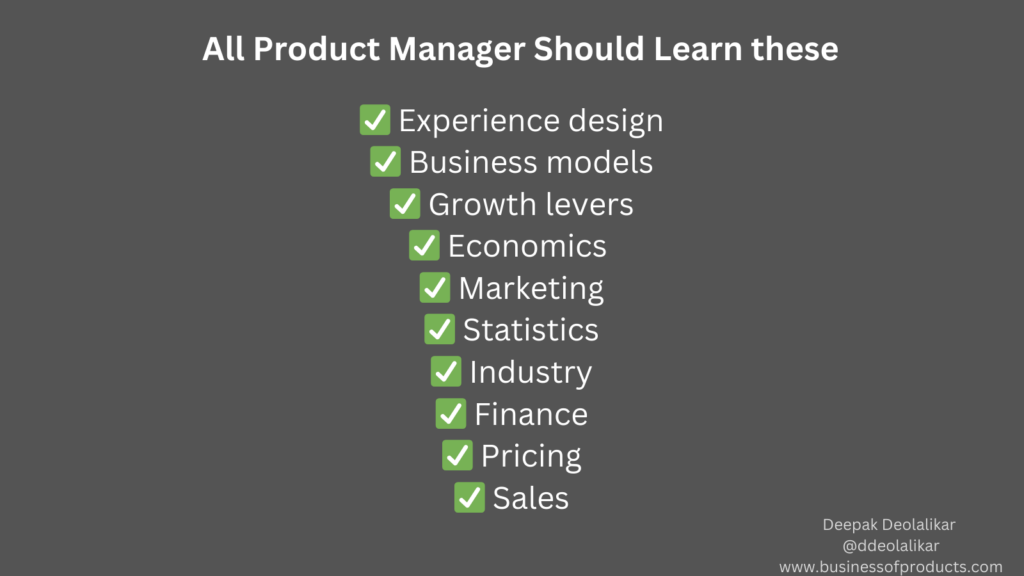
1. Experience Design — AI Makes This Harder, Not Easier
Everyone assumes AI will make products smarter and easier to use. Often the opposite happens.
AI outputs are unpredictable. They fail in ways users don’t expect. A chatbot that gives a wrong answer with total confidence destroys trust faster than a feature that just doesn’t work.
Good UX in the AI era means designing for failure gracefully, setting honest expectations, and making sure users always know what to do next when the AI gets it wrong. If you can’t articulate the user’s path when the AI fails, you don’t have a product yet.
Pick any AI product you use today. Notice how frustrating it is when it confidently gives you the wrong answer. That’s a design problem. Learn to solve it.
2. Business Models – Know What the AI Actually Costs You
LLMs are expensive to run. Inference costs are real. And your customers’ willingness to pay hasn’t magically gone up because you added AI.
This is where most AI products fall apart. A feature that costs you $2 per user per month to deliver, buried in a $30 plan, is a losing bet at scale.
Before you build any AI feature, map the business model. What does it cost to deliver?
What does the customer get in return? Can they get 10x the value of what they pay? If yes, you have something. If not, you’re subsidizing a feature nobody truly needed.
Read Business Model Generation by Osterwalder. Then layer in the AI cost structure your engineering team is actually facing.
3. Growth Levers — AI Changes How Products Grow
The old growth playbook was: acquire users, activate them, retain them. AI adds a new wrinkle — the product gets better with use, which can be a powerful retention lever. But only if you design for it.
The PMs winning right now are identifying specific moments where AI creates an “aha” moment that a non-AI product couldn’t deliver. That’s your growth lever.
Study how tools like Cursor or Perplexity are growing. It’s not traditional acquisition. Users are converting because the product does something they couldn’t do before, not just faster. Find that moment in your product and build toward it.
4. Marketing — Buyers Are Researching Differently Now
This one is urgent and most PMs are completely ignoring it.
B2B buyers are no longer just Googling your product. They’re asking ChatGPT, Perplexity, and Claude. They’re getting AI-generated shortlists before they ever visit your website. If your product isn’t showing up in those answers, you’re invisible to a growing segment of buyers.
That’s not just an SEO problem. It’s a positioning and distribution problem.
PMs need to own the question: how does our product get found when a buyer asks an AI assistant what tools to use? That means clear, consistent, specific positioning — not vague category language. Read Obviously Awesome by April Dunford. It was written for this exact challenge, even before AI search existed.
5. Economics — AI Is Reshaping Entire Markets, Not Just Features
In some industries, AI isn’t a feature. It’s a full disruption. The question is whether it’s disrupting your competitors or you.
Entire cost structures are changing. Services businesses are being replaced by software. Software products are being replaced by AI agents. Buyer procurement cycles are shortening. Willingness to pay is shifting because the alternatives are getting better fast.
PMs who understand basic economic forces — supply, demand, substitution — will see these shifts coming. Those who don’t will be surprised when their retention numbers start dropping and can’t explain why.
Follow what’s happening in your specific industry beyond your product. The macro forces matter.
6. Statistics — AI Outputs Are Probabilistic, Your Decisions Should Be Too
This is the most underrated skill gap in product right now.
AI doesn’t give you right or wrong answers. It gives you probabilistic outputs. A model that’s right 90% of the time sounds great until you’re building a product where a 10% error rate destroys user trust or creates legal liability.
PMs who understand statistics can set honest expectations with customers, make smarter build vs. buy decisions, and evaluate whether that AI feature is actually working or just feels like it is. “Our AI improved conversion” means nothing without knowing the baseline, the sample size, and whether the result is statistically significant.
Most PMs are not trained here. It’s a real edge if you put in the work.
7. Industry — AI Is Not Hitting Every Industry the Same Way
The AI hype is general. The actual impact is specific to each industry.
In healthcare, regulation will slow AI adoption significantly. In legal, liability concerns dominate. In B2B SaaS, the shift is happening in how buyers research, evaluate, and buy — not just in how they use the product.
A PM who understands their industry’s specific constraints, procurement cycles, and competitive dynamics will make better AI product bets than one who’s just following the general AI news cycle.
Read industry-specific research. Talk to buyers about what they’re actually changing in their workflow versus what they’re experimenting with. The gap is usually large.
8. Finance — The AI Business Case Is Harder Than It Looks
Most AI features are easy to demo and hard to justify in a P&L.
Leadership will ask: what’s the ROI? What does this cost us to build and maintain? How does this affect our gross margin? If you can’t answer those questions, someone else will answer them for you — and you won’t like the outcome.
PMs need to build the business case for AI investments with real numbers, not just “this will improve user experience.” Quantify the expected retention lift. Model the infrastructure cost. Estimate the support cost reduction. Make it concrete.
I once had to model a joint product offering and recommend to leadership that we walk away because the economics didn’t work. That’s the job. Be willing to do that.
9. Pricing — AI Creates New Pricing Opportunities Most PMs Are Missing
Usage-based pricing is becoming the default for AI products because the cost structure is usage-based. But most PMs are still defaulting to flat monthly subscriptions because that’s what they know.
Think carefully about what your customer is actually getting. Is it time saved? Revenue generated? Decisions made faster? Price against the outcome, not the feature. A product that saves a customer $50,000 a year in manual work can be priced very differently than one that “enhances productivity.”
AI also creates natural upgrade triggers. A user who hits a usage limit on an AI feature is primed to upgrade in a way that a user who hits a seat limit is not. Design your pricing to capture that.
10. Sales – Customers Are Confused About AI, and That’s Your Problem to Solve
Customers are skeptical. They’ve been burned by AI demos that didn’t survive contact with real workflows. They don’t know what to trust.
Getting on calls and hearing those objections firsthand is how you build a product that actually sells. “We tried an AI tool and our team stopped using it after two weeks” is the most valuable sentence a PM can hear right now.
Sit in on ten sales calls this quarter. Listen for where AI comes up. Listen for the hesitation. Listen for what the customer is actually trying to get done versus what they’ve been sold before. Build for that gap.
The Skill That Ties All Ten Together: Judgment
Anyone can add AI to a product. The hard part is knowing when it adds real value, when the economics work, when your customer is ready for it, and when you’re just chasing noise.
The PMs who will win in this cycle combine business sense with honest thinking about what AI can and can’t do. Not the ones with the most impressive AI roadmap.
Start observing the world and the products you see everyday. Ask questions – Who is this product for? What are they willing to pay? Whats the alternate? What is the value customers receive?
A great Product Manager does much more than just writing JIRA tickets and managing backlogs. The best PMs understand business, growth, and strategy at a deep level. They think beyond features and focus on building products that create real value.
They build product sense.
